
Subsidence repair in Bristol
Cracks appearing in your home are unsettling, and the first thing you want to know is whether they are serious and who can put them right. If subsidence is behind the cracks, this page will explain what is happening beneath the property, how it can be fixed, and how to find out for certain if the property is experiencing subsidence. You can book a free site inspection and one of our engineers will investigate the issue further.
Why subsidence is common in Bristol
Subsidence occurs when the ground beneath a foundation sinks or shifts, causing the building to settle unevenly. Bristol experiences that more than much of the West Country because of its soil conditions. Much of the city and the surrounding area sits on a sequence of red mudstones, siltstones and clay-rich materials. These soils can present significant challenges for buildings and infrastructure because their engineering properties can vary considerably across relatively short distances.
In residential areas, weathered Mercia Mudstone can soften over time, particularly where drainage defects allow water to infiltrate the ground. Changes in moisture content may reduce bearing capacity, create localised soft spots and contribute to uneven foundation support.
The Bristol homes most at risk
Bristol's older housing stock is more at risk. The Georgian and Victorian terraces around Clifton, Redland and Cotham were built with shallow foundations, so they experience soil movement quicker. The inter-war and post-war semis in the surrounding areas have their own familiar patterns. This doesn't automatically mean your home is in trouble, it simply helps us understand the likely cause quickly once we are on site.
The signs worth taking seriously
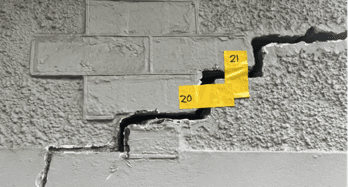
Not every cracked wall means subsidence. Fine hairline cracks can develop as the house experiences temperature fluctuations as the seasons change. The ones to act on tend to be diagonal, wider at the top than the bottom, wider than about 5mm, and they often spread from the corners of windows and doors. Sticking doors and windows can be another sign that the frame has shifted. If these signs sound familiar, arranging a site survey is the best way to know for certain. Our guides on cracked wall, sticking doors and sloping floors explain each sign in more detail.
How we repair it, and why it is less distruptive than most people fear
The type of remediation work depends on the cause, which is why we survey first rather than generate a quote based on assumptions. Traditional underpinning, which involves excavating beneath the foundation and extending it down to firmer ground, is well established and sometimes the best option. For many Bristol homes, we use resin injection as an alternative. A structural resin is injected into the ground through small holes below the foundation, where it expands to fill the voids and lift the structure gently back towards level. No excavating and rebuilding is needed, meaning far less mess, work can take a few days rather than several weeks, and in many cases, you can stay in your home while works are carried out.
Working with your insurer
Subsidence is covered by most buildings insurance policies, usually with a higher excess than a standard claim. Once your insurer has accepted a claim, we'll work alongside them and their loss adjuster right at the start, so you’re not left to manage it on your own. If you're unsure whether to make a claim, a site inspection and quote will help you make a decision. Our guide to subsidence insurance claims explains what happens after a claim is accepted.
Why choose Mainmark?
• Direct contractor
• No third-party lead generation
• Engineers are employed by Mainmark
• Established since 1989
On a recent project, a semi-detached home had subsided by up to 80mm. The movement was caused by a combination of tree roots drawing water out of the clay soil beneath the foundations and a leaking drain, which washed away the soil. Our team re-levelled the whole property by 50mm with resin injection in seven days, with no demolition and the occupants were allowed to stay in the property.
Areas we cover
We work throughout Bristol and the surrounding towns, including Bath, Keynsham, Yate, Thornbury, Portishead, Clevedon, Nailsea and Weston-super-Mare.
Book a visual inspection
If you’re worried about the appearance of cracks in your home, or your insurer has accepted a claim and you want the repair work done properly, book a free inspection. Our engineers will assess the property, tell you plainly whether it is subsidence, and explain your options with no obligation.
Common questions
Will claiming for subsidence increase my premium?
It can, and you may find that your home becomes a little harder to insure when you renew or sell. It’s worth understanding the cause before you decide to claim. An assessment will give you a better picture.
What if my insurer rejects my claim?
Enter your answer
How long do subsidence claims take?
Enter your answer
Does home insurance cover subsidence?
Enter your answer
Can I stay in my home during the repair?
Enter your answer